Lessons Learned – v.3

It’s mid-summer, which makes it the perfect time for another installment of Lessons Learned.  I’ve been thinking that this would be a great habit for me to keep up long after I stop traveling.  It will motivate me to keep living the type of life that allows me to fill pages of a book with interesting, funny, and sometimes hard-earned lessons and give me time to reflect as I navigate my way through life.  I certainly have no shortage of entries as we continue our travels living in 80 square feet of tent each night.

  1. The earth beneath our feet is made up of many colors and shades, not just brown.  I knew this, but it didn’t register completely until we began traveling in Utah.  Utah must have soil that spans every color in the spectrum.  I’ve seen brown, red, orange, pink, white, blue, green, you name it!   Even with all the colors of the rainbow, deep, rich brown is still my favorite.
  2. I am not as dependent on a water spigot as I had thought.  Early on in our travels, we moved along from a campground after one night because it didn’t have any water.  We both felt that access to water from a spigot (even if there were no flush toilets or showers) was indispensable when traveling with a toddler.  Almost every other place we camped, through Nashville, had running water and hot showers.  Since camping in Nashville (oh so long ago), we have not camped in a single place that has had free showers.  Most have had no showers and often no running water except for a spigot to fill water bottles.  The few that did have showers have had pay showers.  We’ve learned to make do quite well by showering (when we feel like it) with our dromedary bag.  It takes some creativity, but it actually works really well.  So well, that we successfully camped for three nights in Canyonlands National Park at a campground with no water at all.  The nearest potable water was a mere ten miles away, but the power for that well actually went out one day, so potable water turned out to be a fifty mile drive away from our site.  And we did just fine.  In fact, that was one of the very best places we’ve camped on this trip.  As long as we make sure to keep all of our water fully stocked when we think we may run into a dry spell, we have absolutely no need to camp with running water.
  3. I acclimate to the heat much more quickly when I live outdoors.  Anyone who knows me well knows that I’m not a hot weather gal.  This, despite the fact that I’ve lived in the DC area for the past eight years.  We just got through with a long day in the sun filled with several hikes and limited shade, and I felt great.  And it was 102 degrees!  Granted, humidity in Utah is just not the concern it was back home, but 102 is 102.  I realize that since I’m not living and working in climate controlled locations, I’m able to adapt much more easily to the weather around me, making my days (and nights) outdoors that much more pleasant.
  4. The only conversation starter better than a toddler is a toddler in a Yankees cap.  I must admit that neither Alan nor I are big into baseball.  The cap was a gift to Van from his Gran, who happens to be the Yankees’ number one fan.  I understand that people might dispute this, but I’m willing to take on that dispute with anyone.  As for the hat, Van gets comments on it wherever we go, and quite a few passionate ones.  There are Yankees fans and Red Sox fans EVERYWHERE!
  5. I’m happier outside.  This isn’t anything new, but it’s never felt more true.
  6. Van is even more flexible than we thought.  We knew that for this adventure to be fun, Van needed to be flexible.  He was already a flexible kid, not too bent out of shape if his nap was a few hours later than usual or even if he had no “usual” nap time as long as he took a nap.  But we had no idea that he’d take so well to living on the road and the irregularity that naturally ensues.  A nap at 11:30 one day and 5 the next?  No problem.  Packing up a campsite every few days for a brand new one?  No problem.  In fact, if we’re not heading out on a hike or a road trip every day or so, we have a little taskmaster on our hands who begs for the next road trip and hike.  And at the end of each, we often get a round of applause and hear our backseat driver/hiker say “good hike” or “good road trip” not too long before requesting more.  This kid cracks me up!
  7.  Busyness does not equal stress.  For most of my life, I was under the impression that when you’re busy, there’s a certain amount of stress that naturally hangs on for the ride.  After the last few months on the road, I now realize that while busyness is sometimes (or maybe even often) accompanied by stress, it is not an automatic passenger.  When we describe to folks that we’re traveling for an indeterminate amount of time, I think that there is the misperception that we’re living a life of leisure with nothing to keep us busy.  While I can’t argue that we are living a certain type of person’s dream life and there is a fair amount of leisure involved, it is also an incredibly busy life.  We’re constantly thinking about where we’re going to sleep that night, where we’re going to buy food, how we’re going to get water, do laundry, get the oil changed, take a shower, get reception to check voicemail and email, calm down a boy who’s had too much sun and too little sleep, and the list goes on and on.  There are many things that become much more complicated when you don’t have a home – especially when you have a two-year old along for the ride.  This is all a long way of saying that I’m busy, not the busiest I’ve ever been (I did work in biglaw), but busy nonetheless.  And it’s not stressful!  It’s a beautiful thing to realize since I thrive on being busy – but now I know that the stress is entirely optional.  Of course, the key is being busy with things you’re in control of, that you enjoy, and that you have enough passion for that you don’t burn out or get bored.
Our Taskmaster, Hard at Play

Our Taskmaster, Hard at Play


Curecanti and the Black Canyon of the Gunnison

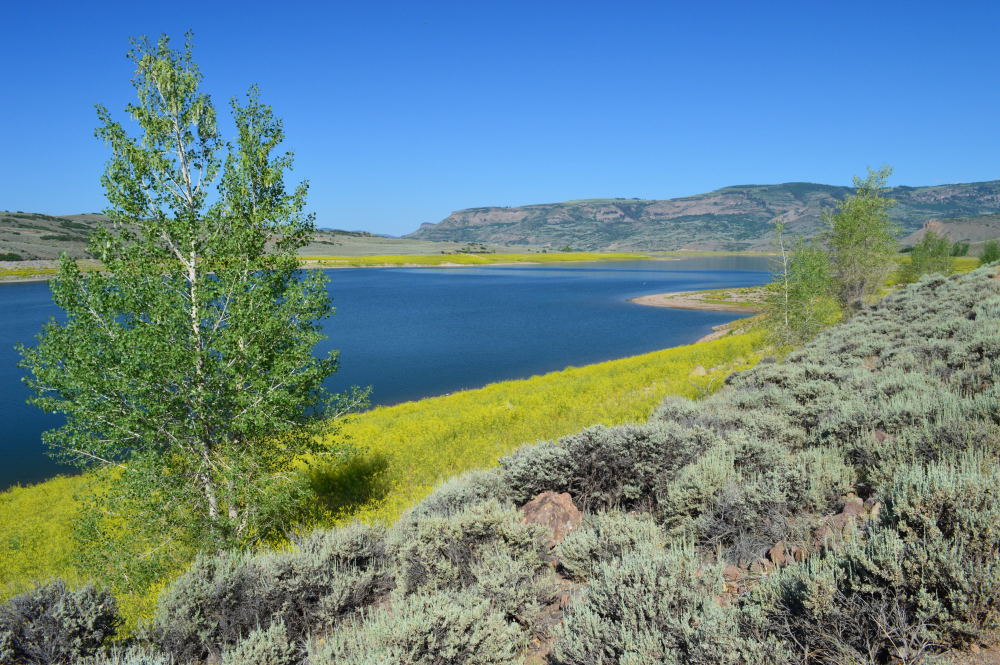
We spent three nights camping just above the Black Mesa Reservoir in Curecanti National Recreation Area.  On our first full day, we explored Crested Butte and partook in one of the most magnificent hikes ever.  On the second day we decided to stick closer to home and explore the surreal landscape of Curecanti.  Although not far from the prototypical Colorado mountains, Curecanti is a beguiling landscape of desert plants, mesas, reds, oranges, and a large blue pool of water that looks just as out-of-place as it is.  The juxtaposition is right out of a storybook or a fantasy movie.  What was once an arid area with a fertile valley where the Gunnison River once ran is now a boaters’ paradise.

Blue Mesa Reservoir in Curecanti

Blue Mesa Reservoir in Curecanti

Blue Mesa Reservoir in Curecanti

Blue Mesa Reservoir in Curecanti

We began our exploration with a several mile hike to the Dillon Pinnacles.  It was a beautiful day and the trail was deserted.  It appears that almost everyone that frequents this park does so with a boat and/or the inclination to get on the water.  That leaves the trails blissfully empty.  As we were hiking to the scent of sage and eventually pine, I was checking out the footprints of the hikers that came before us.  Apparently, many deer like to hike the trail, as well as a few people.  When we were almost to the turn-around point, Van started making his cat noise.  He almost never makes his cat noise unless he sees a cat, so we immediately start asking him if he saw one.  A cat out here on this deserted trail almost assuredly means one thing – a mountain lion.  They’re not frequently seen, but Van has a way of spotting things that is uncanny.  I often think he should be a tracker when he gets older.

As two-year olds tend to do, he will not answer our question about whether he saw a cat.  I’m not sure we’d believe him one way or another anyways.  So, we continue down the path amongst the pines and the pinnacles until I look down and see the unmistakable print of a large cat.  We’ll never know if Van actually saw a mountain lion or if he was just making sounds for fun, but we knew that it was time to turn around and not find out for ourselves.  On the return leg of the hike, Alan commented on how much faster of a hiker I am with the threat of a mountain lion in the vicinity.

Dillon Pinnacles in Curecanti

Dillon Pinnacles in Curecanti

View of the Blue Mesa Reservoir from our Hike

View of the Blue Mesa Reservoir from our Hike

After a morning in the full sun and a sprinkling of adrenaline, we found a rare shaded picnic spot, right next to the boat inspection station.  Van was in heaven.  He loves boats, so to get to watch boat after boat pull up while he ate lunch was a real treat.  We spent the afternoon hiking down into a narrow canyon and along the water, and then later, playing along the shore of the Blue Mesa Reservoir.  We, however, did not get decked out in white mud like the gentleman we saw making an escape through the grasses.

Nope, not a ghost, just a man fully clad in white mud

Nope, not a ghost, just a man fully clad in white mud

Cooling Off in the Blue Mesa Reservoir

Cooling Off in the Blue Mesa Reservoir


Our last and final day in the area was spent in Black Canyon of the Gunnison National Park.  It’s hard to see in photos, but this canyon is DEEP and narrow.  We couldn’t even get a good gauge of how deep it was when we were looking right into it.  I was shocked to learn, as I teetered on the edge of the deepest portion, that the Empire State Building would only come up halfway.  We hiked around the rim a bit and marveled at the sheer drops and the beautiful cliffs, before heading off to find our next camping spot.  This turned out to be a bit more difficult than we anticipated, but we eventually found a great (but not cheap) spot in Ridgway State Park.  It’s in an ideal location, centrally located so that we could explore Telluride and Ouray on different days without having to pack up camp.  More on our fun in those locations in a future post…

On the Road to Shangri-La

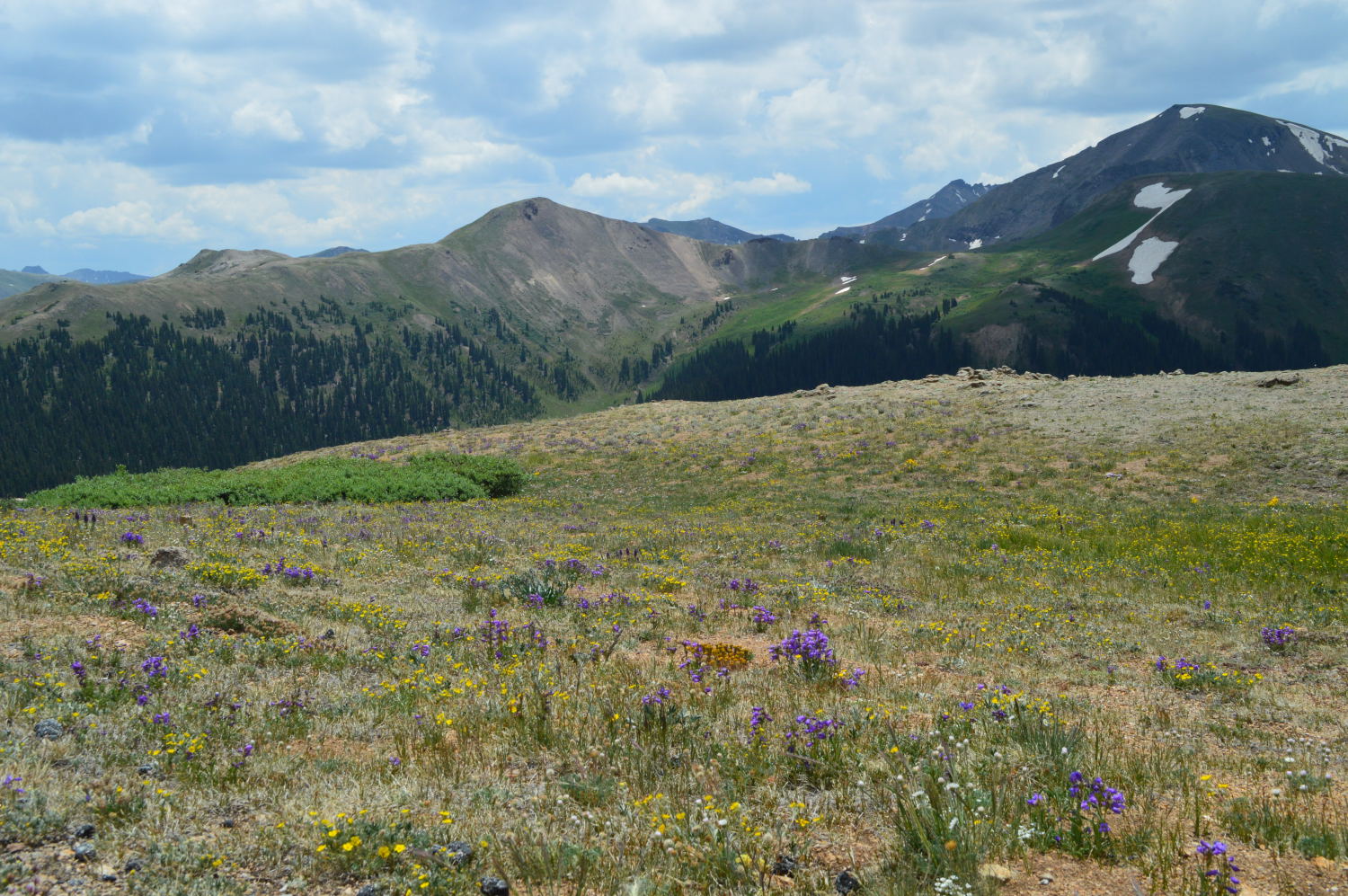
And off we are, once again, with the open road before us and no home awaiting our return.  We drove west from Denver, heading over the Independence Pass to check out Aspen.  The drive over the pass and to Aspen was gorgeous and looked to be a hiker’s paradise.  If we were planning to stay in the area for the night (we weren’t), we definitely would have checked out a couple of the trails in the area.

The View from Independence Pass

The View from Independence Pass

Instead, we headed to downtown Aspen to find a spot to picnic and check out the town.  Alan predicted I wouldn’t think much of Aspen.  He was right.  So on we drove to Carbondale, a town we visited briefly a few weeks earlier.  As we got out of our car, we heard the not-so-distant sounds of a funk band.  Following the music through some backyards and alleyways, we found our way to a park with a large playground for Van.  He played and played and clearly got over his temporary fear of slides while we listened to the funk band warm up for the evening’s concert.  After Van was thoroughly played out, we walked out of the park between a heated croquet game and about fifty or sixty folks doing yoga.  It turns out you don’t need to cut through backyards and alleyways to get to the park, so we took a much more direct way to the main street and did a little wandering before getting back in our car.

Our original plan was to camp for a night just south of Carbondale, but given Van’s mood (it was good), and where we wanted to get the next day, we decided to make today a long driving day and just drive all the way to Curecanti.  We arrived just before the sun was setting, set up a quick camp, and feasted on a smorgasborg of hard-boiled eggs, cheese, crackers, and raisins.  Living the high life, I know!  The campground left some things to be desired for tenters, but it was practically deserted and overlooked the Blue Mesa Reservoir, so we couldn’t complain.

After our first of three nights in Curecanti, we hit the road to check out Crested Butte.  How do I describe this area in a blog post?  Shangri-La comes closest, but it’s hard to describe in words or in pictures – you kind of just have to go there.  The day after we were in Crested Butte we met a family who had been there the same day as us.  As we were sharing our stories of the hikes that we each took, our new friend told us that if she had seen a unicorn, she wouldn’t have been surprised.  This, my friends, is the perfect description of Crested Butte.  Crested Butte: the native habitat for the elusive unicorn.

The Hills Just South of Crested Butte

The Hills Just South of Crested Butte

On the Road to Crested Butte

On the Road to Crested Butte

We started our day in Crested Butte hiking along a river, through wildflower meadows, and up a hill to aspen groves.  Every few steps I proclaimed this to be the most beautiful hike I had ever taken.  And then it would proceed to get more beautiful.  This is the Colorado of postcards and magazine advertisements.  I wanted the hike to go on forever.  But, as all things naturally come to a conclusion, so did our hike.  But not before we waded into the river to a gravel bar in the middle to play and eat lunch.  It was a perfect morning.

We spent the afternoon poking around town and checking out the library, both to entertain Van and to read up on how to change the light that went out on our car just hours after leaving Denver.  The town did not disappoint.  The people were friendly, the architecture was perfect for the location, and the sun was shining.  Now I just need to find someone who has a vacation home in the area and needs a caretaker.

Blog Updates

I’m so happy that there are folks out there following along on our journey!  Since I’m now getting an audience beyond friends and family (!), I’ve made a few updates to the blog over the past couple of weeks.  If you haven’t yet had a chance, check out the updated “Our Route” page and the new “About Me” and “Links” pages.  Also, if you’re not already receiving copies of my new blog posts via email and you’d like to, you can sign up by just entering your email address under the heading: Follow Our Journey via Email, which is on the right side of the page.

One more thing before I go, my blog was recently added to the many great family traveling blogs on www.familiesontheroad.com.  If you’re interested in checking out other families doing something similar, there are many great blogs listed on the site.

Where There’s Smoke…

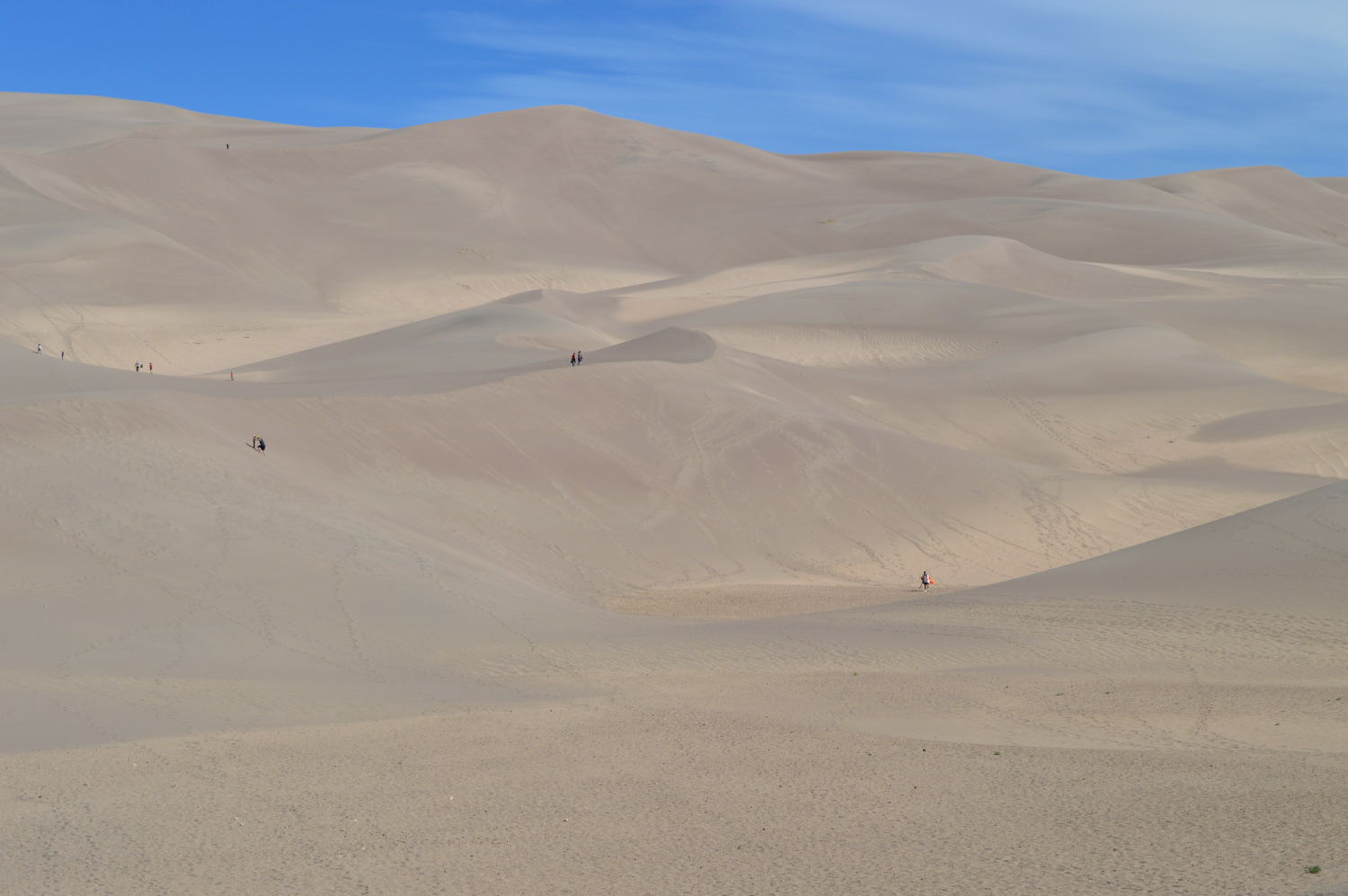
What began as a short camping trip to explore the Great Sand Dunes National Park and nearby Alamosa, quickly turned into a lesson on the impacts of wildfire.  It goes without saying that wildfires have been a huge problem in the western United States yet again this year.  After last year’s disastrous fire in Colorado Springs, another, even more destructive fire broke out, known as the Black Forest Fire.  That fire, along with several others in the state, garnered a fair amount of attention on the local news.  With this in the back of our minds, we set out to drive southwest to one of our nation’s newer national parks, Great Sand Dunes National Park.  It is the home of the tallest dunes in North America and one of the strangest natural sites I’ve ever witnessed.  The dunes seem to arise mysteriously out of the valley against a backdrop of the Sangre de Cristo mountains.

Since we didn’t have reservations (we never do), we opted to head straight to the park campground and claim a spot.  After battling the wind to set up our tent, we decided to check out Alamosa that afternoon and then explore the sand dunes early in the morning when they wouldn’t have absorbed as much heat.  As we were heading down the long straight road that would take us toward Alamosa, we drove right by a bush that was on fire.  Just one bush, completely engulfed in flames.  Given its proximity to the road, we concluded that it was likely the result of a careless and inconsiderate driver who threw a cigarette out of the window.  Luckily we had cellphone reception and were able to speak with a 911 operator to let them know about the fire.  As we continued on down the road, we eventually saw a water truck and then a fire truck coming towards us, about fifteen minutes after we made the call.  They got there pretty quickly considering how far the burning bush was from a town.  When we drove back by the spot to reach our campsite later in the day, we were completely shocked at how large of an area had burned in the short time between the single burning bush that we saw and the arrival of the water truck and firefighters.  It just goes to show how quickly a wildfire can spread with the right weather conditions and plentiful fuel.

A portion of the burned road-side just south of the Great Sand Dunes National Park

A portion of the burned road-side just south of the Great Sand Dunes National Park

After our burning bush sighting, we had a relaxing afternoon in Alamosa playing on the playground and grabbing an early dinner at a local brew pub with, what seemed like, everyone else in town.  But, the whole time we were there, we kept eyeing the smoke coming over the mountains from the southwest, surprised with how imposing it was.  We didn’t realize that the largest wildfire in the state was burning right over the mountain range, the West Fork Complex Fire.  We would be much more acquainted with the fire as the evening progressed.  Just as the winds blew the sand over the San Luis Valley to a natural pocket in the Sangre de Cristo mountains to create the Sand Dunes, the winds blew the smoke from the West Fork Fire to the same pocket, right where we were camping.  Breathing in fairly thick smoke all night did not make for a relaxing night, but with no alternatives, we toughed it out and i thought of all the folks who have to breathe in this smoke on a regular basis.

By the time we awoke, the smoke had begun to clear and we packed up our campsite, ready to explore the dunes.  Alan and I had very different reactions to the dunes.  He thought they were cool, but nothing worth going out-of-the-way for.  I cried the first time I saw them up close.  Yes, very different reactions.

Great Sand Dunes National Park

Great Sand Dunes National Park

We had a great morning walking across the sand to begin climbing up the closest dunes.  Van and Alan loved running down the dunes and I gave sliding down on my butt a try.

After we were tired and ready to head on, we drove east, puzzling at the smoke coming from the southeast, an area that was perfectly clear when we had driven through it yesterday.  Again, unbeknownst to us, a new wildfire had begun overnight, now known as the East Peak Fire.  We passed a number of TV crews setting up to get shots of the smoke coming over the Spanish Peaks as we passed through La Veta and felt like we were in a game of pin the tail on the donkey.  Blindfold us, spin us around, and whichever direction we walk in, there will be smoke.

Smoke coming over the Spanish Peaks from the East Peak fire

Smoke coming over the Spanish Peaks from the East Peak fire

As of July 4th, over two weeks after we visited the Sand Dunes and a month after it began, the West Fork Complex Fire has burned over 110,000 acres and is only 20% contained.  Also as of July 4th, the East Peak Fire has burned over 13,500 acres and is 95% contained.  These are only two of the many wildfires that have raged (and continue to rage) in the west this summer.  Please keep the brave firefighters and local residents in your thoughts as they continue to live with the threats and discomfort of these destructive fires.